
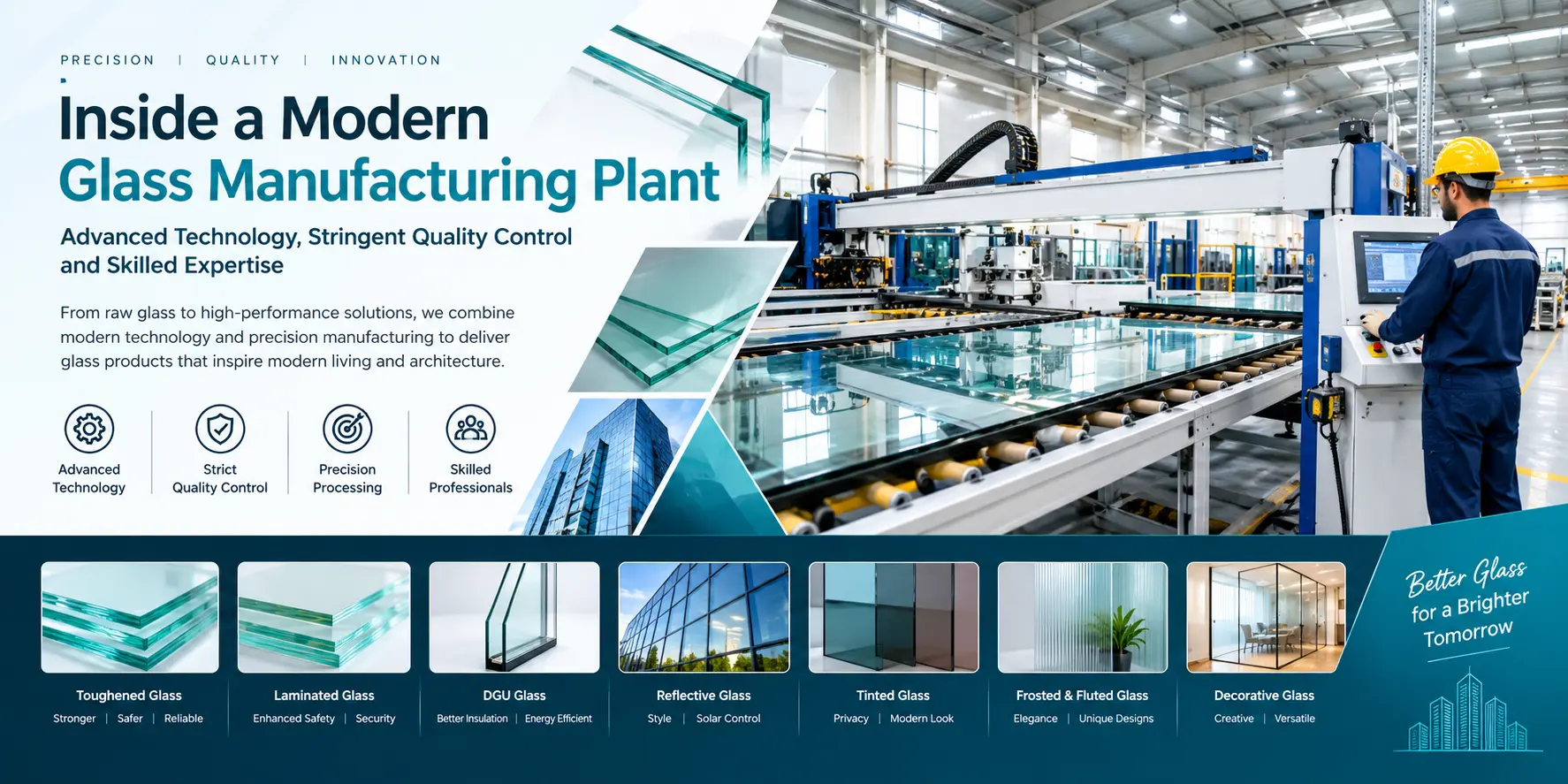
Glass Manufacturer in Jaipur has evolved far beyond its traditional role as a transparent building material. Today, it is an important component of modern architecture, interiors, commercial buildings, façades, doors, windows, partitions, railings, and specialized applications. Behind every high-performance glass product is a carefully controlled manufacturing process where technology, quality control, precision, and skilled expertise work together.
A modern glass manufacturing plant is designed to transform raw glass into reliable, safe, and aesthetically appealing products while maintaining strict standards at every stage. From cutting and edge processing to heat treatment, inspection, and final dispatch, every process contributes to the performance of the finished glass.
Technology Behind Modern Glass Manufacturing
Advanced technology plays a major role in modern glass production. Computer-controlled machinery allows manufacturers to process glass with greater accuracy and consistency than traditional methods.
Automated cutting systems can produce precise dimensions according to project requirements. CNC machines are used for drilling, shaping, and edge processing, helping achieve accurate holes, curves, corners, and customized designs.
For safety glass applications, heat-treatment technology is particularly important. Toughening or tempering involves heating glass to a controlled temperature followed by rapid cooling. This process improves the glass’s mechanical strength and changes its breakage characteristics, making it suitable for many demanding architectural applications.
Modern plants may also use advanced equipment for producing specialized products such as laminated glass, insulated DGU glass, coated glass, reflective glass, tinted glass, fluted glass, frosted glass, and other architectural solutions.
Precision at Every Manufacturing Stage
Precision is one of the most important characteristics of a professional glass manufacturing facility. Even a small dimensional error can affect installation, appearance, or performance.
The process begins with accurate measurement and cutting. Once the required dimensions are established, the glass moves through different processing stages depending on the final application.
Edge grinding and polishing provide smooth and refined edges, while CNC processing enables accurate drilling and shaping. For customized architectural projects, precise coordination between drawings, measurements, machinery, and production teams helps reduce errors and material wastage.
Precision is particularly important for large-format and jumbo-size glass. Large panels require careful handling because their dimensions and weight can make processing and installation more challenging. Modern equipment and trained personnel help maintain consistency throughout production.
Quality Control: More Than Just Visual Inspection
Quality control is an essential part of modern glass manufacturing. A professional plant does not simply produce glass and inspect it at the end. Quality checks are integrated throughout the manufacturing process.
Raw glass is examined for visible defects and suitability before processing. During cutting and fabrication, dimensions, edges, holes, and other specifications are checked against production requirements.
After heat treatment or other processing, finished products undergo additional inspections. Manufacturers may evaluate surface appearance, dimensions, edge quality, optical characteristics, and overall workmanship.
For project-based orders, quality control is especially important because every panel may have specific dimensions and processing requirements. Consistent inspection helps ensure that the finished products are ready for transportation and installation.
Safety and Performance of Toughened Glass
Toughened Glass Manufacture in Rajasthan is one of the most widely used safety-oriented architectural glass products. Its manufacturing process requires controlled heating and rapid cooling to achieve improved strength compared with ordinary annealed glass of the same thickness.
When properly manufactured, toughened glass can be used for applications such as doors, partitions, shower enclosures, façades, windows, railings, and commercial interiors, depending on the project specifications.
One important characteristic of toughened glass is its breakage pattern. When it breaks, it generally fractures into smaller granular pieces rather than large sharp shards. This characteristic makes it a popular choice for many architectural applications where safety is an important consideration.
Specialized Glass for Modern Architecture
Modern glass manufacturing plants can support a wide variety of architectural requirements. Different processing technologies allow glass to provide more than transparency.
Laminated glass can provide enhanced safety and security characteristics by holding glass fragments together with an interlayer. Insulated DGU glass is designed to create an insulating air or gas-filled space between glass panes, supporting thermal and acoustic performance.
Decorative options such as fluted, frosted, tinted, lacquered, acid-etched, and digital-print glass provide designers with greater freedom to create distinctive interiors and façades.
Similarly, reflective and coated glass can be selected for projects where solar control, appearance, daylight management, or energy performance are important considerations.
Why Manufacturing Precision Matters to Customers
For architects, contractors, builders, interior designers, and property owners, manufacturing precision directly affects the installation process. Correct dimensions and properly processed edges can make installation smoother and help minimize on-site adjustments.
High-quality manufacturing also supports consistent appearance across multiple panels. This is especially important for large commercial buildings, façades, showrooms, hotels, offices, residential developments, and other projects where numerous glass panels need to work together visually.
Choosing an experienced Glass Manufacturer in Jaipur can therefore be an important decision for projects requiring customized dimensions, safety glass, architectural glass, or specialized processing.
The Role of Skilled Professionals
Although automation has transformed glass manufacturing, skilled professionals remain essential. Experienced operators monitor machinery, verify measurements, manage production specifications, identify defects, and ensure that safety procedures are followed.
Modern manufacturing is therefore a combination of advanced machinery and human expertise. Technology provides speed and precision, while skilled professionals provide judgment, quality monitoring, and project-specific understanding.
From Factory Floor to Finished Project
The manufacturing journey does not end when the glass leaves the processing line. Proper packaging, handling, storage, and transportation are also important. Glass panels must be protected against scratches, edge damage, impact, and environmental conditions during movement.
A systematic approach from raw material selection to final dispatch helps maintain product quality throughout the supply chain.
For customers, this means that the quality of finished glass depends not on a single machine or process, but on the complete manufacturing system.
Conclusion
A modern glass manufacturing plant is a combination of advanced technology, precision engineering, strict quality control, and skilled workmanship. Every stage—from cutting and edge processing to toughening, inspection, packaging, and dispatch—plays an important role in producing reliable glass for modern applications.
As architecture continues to demand larger, safer, more energy-efficient, and visually distinctive glass solutions, modern manufacturing technology will remain essential. Choosing a capable and quality-focused manufacturer helps ensure that glass products meet the required dimensions, appearance, safety expectations, and project specifications.
Frequently Asked Questions
1. What happens inside a modern glass manufacturing plant?
A modern glass plant typically includes processes such as glass cutting, edge processing, drilling, CNC shaping, heat treatment, quality inspection, packaging, and dispatch, depending on the type of glass being produced.
2. How does technology improve glass manufacturing?
Advanced machinery improves dimensional accuracy, production consistency, processing speed, customization capabilities, and quality control while helping reduce production errors and material wastage.
3. Why is quality control important in glass manufacturing?
Quality control helps identify dimensional errors, surface defects, edge problems, and processing issues before the finished glass reaches the customer. This supports better installation and consistent product performance.
4. What types of glass can modern manufacturing plants produce?
Depending on the facility and equipment, modern plants can manufacture or process toughened, laminated, DGU, reflective, tinted, fluted, frosted, coated, lacquered, acid-etched, digital-print, and other architectural glass products.
5. Why choose an experienced glass manufacturer?
An experienced Glass Manufacturer in Rajasthan can provide better process control, accurate customization, professional quality inspection, appropriate glass selection, and reliable production for residential, commercial, and architectural projects.