Modern architecture increasingly relies on large glass surfaces for natural light, open views, attractive façades, balconies, partitions, doors, and commercial interiors. However, glass selection should go beyond appearance. High-performance safety glass is engineered to provide improved resistance, safer breakage characteristics, and enhanced protection for people and property.
Understanding how safety glass works can help architects, builders, interior designers, and property owners make better decisions when selecting glazing for residential, commercial, and industrial projects.
What Makes Safety Glass Different?
Ordinary glass can break into large, sharp pieces when subjected to significant impact. Safety glass is specifically designed to reduce the risk associated with breakage.
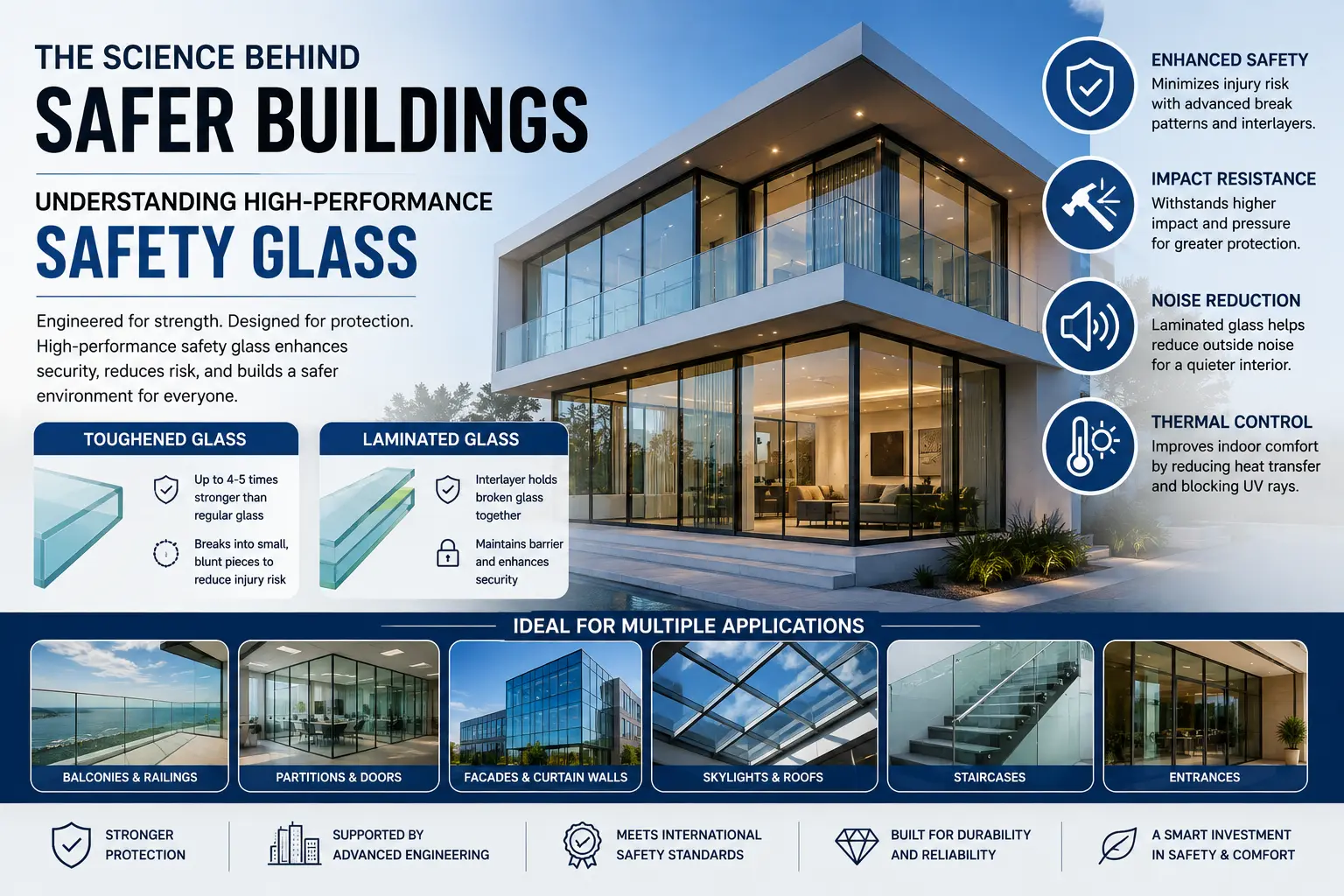
Two major categories are toughened glass and laminated glass. Each uses a different engineering principle to improve safety and is suitable for different applications.
The Science Behind Toughened Glass
Toughened glass, also known as tempered glass, is manufactured through a controlled heating and rapid cooling process. The glass is heated to a high temperature and then cooled quickly using controlled air jets.
This process creates a different stress pattern within the glass. The outer surfaces are placed under compression while the interior remains under tension. As a result, toughened glass generally offers considerably greater resistance to thermal stress and mechanical impact than comparable untreated glass.
One of its most important safety characteristics appears when it breaks. Instead of producing large sharp shards, properly toughened glass typically breaks into many smaller granular pieces. This can significantly reduce the likelihood of severe cutting injuries.
Understanding Laminated Safety Glass
Laminated glass uses a different approach. It is made by bonding two or more glass panes with a strong interlayer, commonly a polymeric material.
If the glass is damaged, the interlayer helps hold the broken pieces together. Rather than immediately falling away as individual fragments, the glass can remain substantially attached to the interlayer.
This characteristic makes laminated glass particularly useful where maintaining a barrier after breakage is important.
Toughened vs Laminated Glass
Both glass types improve safety, but their performance characteristics are different.
Toughened Bend Glass Manufacturers in Jaipur is valued for its high mechanical and thermal resistance and its safer breakage pattern. Laminated glass is valued for retaining broken glass and maintaining a degree of integrity after impact.
The right choice depends on the application’s requirements. In some projects, a combination of both technologies may provide an effective solution.
Why Safety Glass Matters in Modern Architecture
As buildings incorporate larger windows, glass doors, frameless partitions, skylights, façades, and balcony systems, the consequences of glass failure become increasingly important.
High-performance safety glazing can contribute to:
- Improved occupant safety
- Better resistance to impact and thermal stress
- Safer breakage characteristics
- Retention of broken glass in laminated systems
- Enhanced security in selected applications
- Improved acoustic performance with suitable laminated configurations
- Greater design flexibility for modern architecture
Safety glass should therefore be considered a functional building component rather than simply a decorative material.
Safety Glass for Doors and Partitions
Glass doors and partitions are frequently located in areas with high pedestrian movement. People may accidentally walk into transparent surfaces or impact doors while carrying objects.
Using an appropriate safety glazing specification can reduce the hazards associated with accidental breakage. Toughened glass is commonly used for many interior applications because of its strength and breakage characteristics.
For situations where post-breakage retention is important, laminated glass can provide additional benefits.
Safety Glass for Balconies and Railings
Balconies and glass railings require careful consideration because glazing can form part of a fall-protection system. The glass configuration, thickness, support system, edge treatment, hardware, and installation method all influence performance.
Laminated safety glass is often considered for applications where retaining the glazing after breakage is an important design requirement. The exact specification should always be determined according to applicable standards and structural requirements.
Safety Glass for Facades and Commercial Buildings
Large commercial façades may be exposed to wind loads, temperature variations, accidental impacts, and other environmental stresses. High-performance glazing can help address these demands when properly specified as part of a complete façade system.
In addition to safety, architects may combine safety glazing with solar-control, Low-E, acoustic, or insulated glass technologies to achieve multiple performance objectives.
The Role of Glass Thickness and Configuration
Safety is not determined by glass thickness alone. A thicker pane may provide greater resistance in some situations, but performance also depends on the glass type, dimensions, support conditions, edge quality, loading, interlayer, and overall system design.
For Laminated Glass suppliers in jaipur or insulated configurations, the interaction between individual components is equally important.
This is why glass should be selected based on engineering requirements rather than simply choosing the thickest available product.
Safety and Installation Go Together
Even high-performance glass can underperform if it is incorrectly installed. Frames, gaskets, sealants, setting blocks, hardware, drainage, clearances, and supporting structures must be appropriate for the glazing system.
Professional fabrication and installation are therefore essential for achieving the intended performance of safety glass.
Choosing the Right Safety Glass
The best safety-glass solution depends on where and how the glass will be used. A residential shower enclosure may have different requirements from a high-rise façade, balcony railing, office partition, or commercial entrance.
Important factors include impact exposure, wind load, thermal conditions, human traffic, fall protection, acoustic requirements, security needs, glass dimensions, and relevant building standards.
Consulting an experienced glass manufacturer or glazing professional can help ensure that the selected configuration matches the project’s technical requirements.
The Future of Safer Glass Architecture
High-performance safety glass is helping architects create buildings that combine transparency, natural light, modern aesthetics, and improved protection. Technologies such as toughened, laminated, insulated, Low-E, and multifunctional glazing can be engineered individually or combined to address specific building requirements.
For modern construction projects, the goal is not simply to use more glass—it is to use the right glass, in the right configuration, for the right application. With proper specification, fabrication, and installation, safety glass can become an important part of creating more secure, comfortable, and high-performing buildings.
Frequently Asked Questions
1. What is high-performance safety glass?
High-performance safety glass is specially engineered glazing designed to provide improved resistance to impact, thermal stress, or breakage hazards. Toughened and laminated glass are two common safety-glass solutions.
2. Is toughened glass safer than normal glass?
Toughened glass is designed to provide greater strength and a safer breakage pattern than ordinary annealed glass. When it breaks, it generally fragments into smaller pieces rather than large sharp shards.
3. Why is laminated glass used for safety applications?
Laminated Glass suppliers in jaipur contains an interlayer that helps hold glass fragments together after breakage. This retention characteristic can be valuable where maintaining a barrier after impact is important.
4. Can safety glass be used for balconies?
Yes, safety glazing can be used for balcony applications, but the appropriate glass configuration must be determined according to structural loads, dimensions, support conditions, applicable standards, and the specific railing system.
5. How do I choose between toughened and laminated glass?
The choice depends on the application’s safety, structural, acoustic, security, and post-breakage requirements. In certain applications, combining toughened and laminated technologies may provide additional performance benefits.